|
Hyperopia -
(Farsightedness)
Hyperopia is another name for
farsightedness. Farsighted may sound like the opposite of
nearsighted, but it is not. Farsightedness is actually very
different from nearsightedness.
Nearsighted people can
see close up objects and have trouble with seeing objects at a
distance. Farsighted people have trouble focusing on objects in
general due to a refractive error in the eyes.
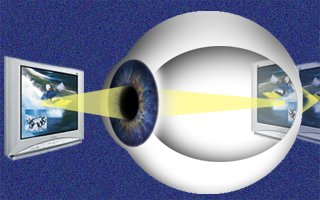
Refraction
is the bending of light. When a light wave enters the eye, it is
bent by the cornea as it makes its way through to land on the
retina. In a normal eye, the flexibility of the lens, the
curvature of the cornea and the length of the eye work together
to produce a clear image on the retina. |
 |
|
In a farsighted person, either the eye is too short or the cornea is too
flat. This causes the point of focus to occur behind the retina instead
of on top of it. Hyperopia is not an eye disease, but an eye
disorder. Because of the role refraction plays in farsightedness,
hyperopia is known as a refractive disorder.
Causes
Hyperopia, or farsightedness, is generally present from birth. It may
not be instantly recognizable in mild cases, which can go undetected for
years until the child is old enough to recognize images. At that point,
the farsightedness can become apparent.
It is quite normal for
many children to be farsighted, when they are younger. In
many children, the farsightedness disappears before the teenage years.
Onset and Treatment
Although farsightedness
is normally present at birth, the eye can correct itself naturally as it
grows. The eye stops growing around age nine. If at that point there is
still a small amount of farsightedness present, the lens of the eye may
change its shape to fix the eyes’ vision, a process called
accommodation.
Around age forty when the eyes start to
degrade, the lens can lose its flexibility and this
accommodation can disappear, resulting in a condition called
presbyopia. Presbyopia is actually a natural symptom of the
aging process and refers to the eyes’ diminishing ability to
focus.
Around this age people start having trouble with
close work- any work that requires the eyes to focus on an
object close to them. They may also have trouble seeing objects
far away as well.
Symptoms of hyperopia include
headaches, aching eyes, eye strain and trouble seeing objects
that are up close. |
 |
|
A farsighted person may need to wear glasses or contacts to correct
their vision or they may need no treatment at all as the eye can adjust
to make up for the farsightedness. Farsightedness is common in
children and often has no impact on the quality of life for the
farsighted child in most mild cases.
A
child with hyperopia may rub their eyes a lot, complain of headaches,
and may have trouble reading. This difficulty with reading may present
as a lack of interest in younger children.
Hyperopia in children
can be hard to detect. For example, a child who has hyperopia may not
stand very far away from the TV screen to see. They may stand right up
close to it.
This is because the farsighted child is used to not being
able to focus on finer details and standing closer to the screen allows
them to at least see blurry images.
Their eyes have never been able to
see fine detail, unlike a nearsighted child, who knows they can see fine
detail at certain distances. A nearsighted child has very good vision at
a closer range and is used to being able to see detail when
objects are held close to the face. |
 |
|
The compensating behavior of a nearsighted child and a farsighted child
might look the same on the outside. Only an eye exam by a professional
can diagnose whether a child is farsighted or nearsighted.
Advanced Treatment
Farsightedness
in adults can be corrected via several surgical and non-surgical
options:
• Conductive
keratoplasty: a non-surgical method where low-energy radio waves are
used to re-shape the cornea. The waves shrink the connective tissue that
hold the cornea in place and cause it to be stretched back into shape.
• Laser eye surgery: A surgical procedure where vision is
corrected by removing a small part of the eye with a laser. By using a
highly focused laser beam, a expert cuts away a bit of eye tissue,
flattening the cornea and correcting the focus.
• Intraocular
lens transplant with clear lens extraction: A surgical procedure where
the eye’s natural lens is replaced by an implant. The natural lens is
removed, and a synthetic lens is put in its place. This allows most
people to achieve 20/40 vision or better over time.
Diagnosis
Diagnosis of hyperopia can be made with a complete routine eye exam. The
exam consists of questions about the patient’s eye sight and a physical
inspection of the eyes.
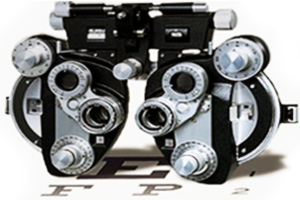
The eye doctor's inspection of the eyes consists
of several tests. A retinoscope allows the doctor to see the surface of
the retina, while phoropter allows them to measure the refractive error
of the eye and assign a prescription.
When other causes
of farsightedness, such as eye disease, are ruled out and the problem
with vision is determined to be a refractive error, the doctor will use
a phoropter. This is the machine that allows the doctor to show a series
of lenses to a patient, switching back and forth between them to
determine the best fit for corrective lenses. |
 |
Risks
In extreme cases of
farsightedness, glasses may be needed to prevent accommodative esotropia,
a crossing of the eyes. As the eye works to accommodate for
farsightedness, the eyes may become crossed. Wearing glasses can
straighten out the eyes and prevent them from crossing.
Another
problem that can develop from extreme farsightedness is amblyopia. This
is the most common cause of vision problems in children. Amblyopia is “a
lazy eye”. It is caused by the brain ignoring signals from an eye
producing blurred images, which makes the ignored eye weaker over time
as it is not being used by the brain. Corrective treatment can include
wearing glasses or wearing a patch over the normal eye to strengthen the
weakened one.
Prevention
There is no path of prevention for
hyperopia. Taking care of your overall health is the best way to take
care of your eye health. Not smoking, exercising and eating a healthy
diet high in antioxidants are all ways to take care of your eyes by
taking care of your body.
When to see an eye care professional
If
you notice your child is squinting a lot or sitting closer to the TV, or
if they have trouble catching a tossed ball, they might be affected by
hyperopia. In adults, you may notice increased eye strain and headaches,
trouble performing close work or aching eyes.
Always see an eye
care professional immediately if you have any sudden changes in vision. This
includes darkening around the edges of your vision, dark spots in front
of your eyes, halos around bright lights, a loss of vision in one part
of your field of sight or any other noticeable change.
|